How to Analyze Your Competitor’s Backlinks and Build a Plan to Overtake Them
If you read Blog 1 in this series, you already know why your competitor outranks you. They have more credible websites pointing to theirs — and that gap in backlink authority is what’s keeping you off page one. Now comes the part most operators never reach: actually doing something about it. Towing competitor backlink analysis is not complicated once you know the steps. Your competitor’s backlink profile is sitting right there, completely visible to anyone who knows where to look. Every link they have is a link you can target. Every source they’re listed on is a source you can get listed on too.
This blog walks you through exactly how to find it, read it, and build your plan from it.
Why Your Competitor’s Backlink Profile Is a Gift
Your competitor has already done the hard work of figuring out which local sources will link to a towing company. They’ve been listed in directories. They’ve earned mentions from local businesses. They’ve built relationships with local publications.
All of that research is sitting in their backlink profile — and you can access every bit of it without spending a dollar.
This is what towing SEO competitive research actually means in practice. Not guessing what might work. Not copying their website design. Reading exactly which sites have vouched for them — and going to those same sites to get the same vouch.
Step 1: Identify Your Real Google Competitors
Before pulling any data, you need to identify the right competitors to analyze — and they may not be who you think.
Your Google competitors are not necessarily the companies you compete with for jobs day to day. They’re the companies showing up above you in search results for your target keywords right now.
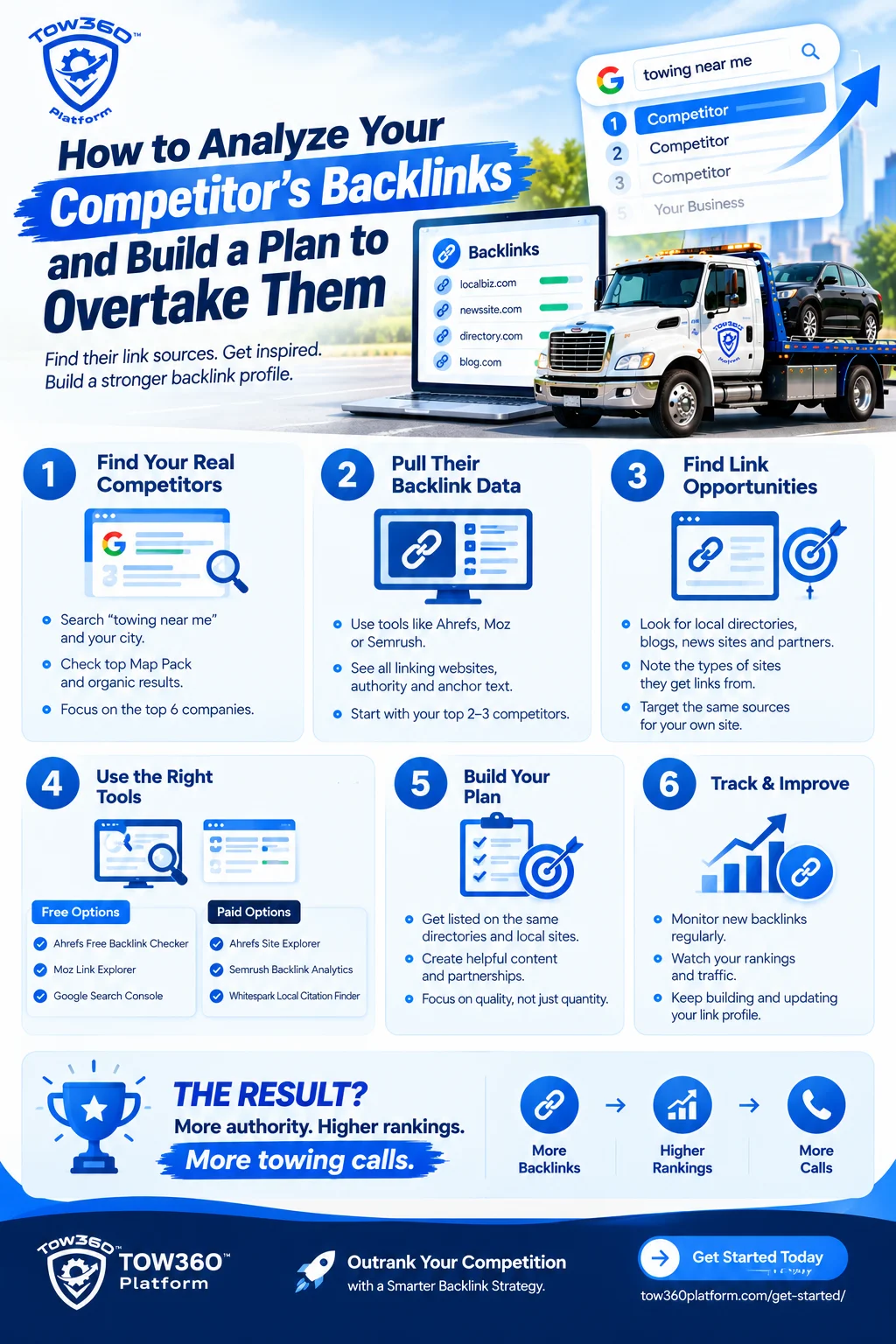
Open Google in an incognito window. Search “towing near me” and “towing [your city].” Write down the top three companies showing up in the Map Pack and the top three in organic results. Those six companies are your actual competitors for this analysis — regardless of their physical proximity to your yard.
Want to Rank Organically?
Contact Us Now!
Step 2: Pull Their Backlink Data
Now you run the analysis. Here’s how how to check competitor backlinks towing operators need to know — using tools that actually work.
Take your competitor’s website URL. Go to one of the tools below and enter it. You’ll see every website linking to them, the authority of each linking site, when the link was built, and what anchor text was used.
Start with your top two or three competitors. You don’t need all six at once. The patterns will repeat and become obvious quickly.
What Tools Can I Use to Analyze Competitor Backlinks?
This is the most common question operators ask — and the good news is you don’t need to spend hundreds of dollars to get started.
Free options that work for local towing operators:
- Ahrefs Free Backlink Checker — enter any URL and see the top 100 backlinks, domain rating, and referring domain count. No account required. This is the fastest free starting point for any free backlink checker towing website analysis.
- Moz Link Explorer — 10 free searches per month. Shows domain authority, linking domains, and top pages. Reliable for a quick competitive read.
- Google Search Console — free if you’ve verified your own site. Shows every backlink pointing to your website. Use this to understand your own baseline before comparing to competitors.
Paid options worth the investment:
- Ahrefs Site Explorer — starts at $129/month. Best-in-class backlink database with 326 billion indexed pages. The Link Intersect feature shows domains linking to your competitors but not to you — your instant priority list.
- Semrush Backlink Analytics — starts at $139/month. Excellent for running backlink gap reports across multiple competitors simultaneously. Strong for operators managing several markets.
- Whitespark Local Citation Finder — starts at $39/month. Specifically built for local businesses. Shows which citation sources competitors are listed on that you aren’t. Best tool for local-specific gap analysis.
For most towing operators just starting this process, the free Ahrefs checker gives enough data to build an initial action plan before committing to a paid subscription.
Step 3: Read the Data — What to Actually Look For
Pulling the data is straightforward. Knowing what matters is the skill. Here’s what to focus on when reviewing a competitor’s backlink profile.
Referring domains — not total backlinks.
A competitor with 200 backlinks from 12 different websites is far less authoritative than one with 80 backlinks from 60 different domains. Diversity of sources matters more than volume. Always sort by referring domains first.
Domain Rating or Authority Score of each linking site.
A link from a site with a domain rating of 45 is worth more than 30 links from sites rated under 10. Flag any high-authority links in your competitor’s profile — local news sites, industry associations, government directories — these are your priority targets.
Link types — directories, editorial, or partnerships.
Directory links are the easiest to replicate. Editorial links from local news or community organizations require more effort but carry far more weight. Identify what percentage of your competitor’s profile is each type — it tells you exactly where to start.
Local relevance of each linking site.
A link from the local Chamber of Commerce in your city is worth more for your local rankings than a link from a national blog with ten times the authority. For backlink gap analysis towing company operators running, filter by local-domain links first — those are your fastest wins.
What Types of Backlinks Do Top-Ranking Towing Companies Have?
After analyzing dozens of top-ranking towing company websites across competitive U.S. markets, the same link types appear consistently in every high-performing profile.
Local business directories and citation platforms:
Yelp, BBB, Foursquare, Apple Maps, Bing Places, and industry-specific directories like Towbook and NationaLease. These are table stakes — if your competitor has them and you don’t, fix that first.
Chamber of Commerce and local business associations:
These links carry disproportionate local authority weight. Google treats chamber directories as trusted local signals. A link from a local Chamber of Commerce or a well-known regional business site carries more weight for local rankings than a link from a national blog — and getting listed typically costs nothing beyond membership.
Local auto repair shops, dealerships, and body shops:
Backlinks from local auto repair shops, auto body centers, and car dealerships carry disproportionate weight for towing companies because they establish geographic co-citation. These are partnership links — usually earned through referral relationships that benefit both businesses.
Local news outlets and community websites:
The highest-authority local links available. When a local publication runs a story mentioning your company — or lists you in a local business directory — that link produces ranking movement faster than almost any other source. Monitor your competitor’s news mentions specifically.
Roadside assistance networks and insurance referral pages:
Industry-specific, high-intent, and trusted by Google as relevant to the towing category. If your competitor is listed on a roadside assistance network referral page and you aren’t — that’s a direct call channel you’re missing.
Step 4: Build Your Gap List
Now you have the data. Next step: steal competitor links towing business operators should target by building a prioritized gap list.
Open a simple spreadsheet. List every referring domain your competitor has that you don’t. Add a column for domain authority of each source. Add a column for link type — directory, editorial, partnership, or citation.
Sort by: local relevance first, then domain authority, then ease of acquisition.
Your top priority targets are local directories and citation sources your competitor is listed on that you aren’t — these are typically free or low-cost to get listed on and produce results within 30 to 60 days of indexing.
Your secondary targets are partnership links from local auto shops, dealerships, and industry networks. These require outreach but produce high-authority, locally relevant links that compound over time.
Your long-term targets are editorial links from local news and community publications. Plan content worth covering, get involved in the community, and build the relationships that produce these links organically.
Step 5: Track Your Progress
Analysis without tracking is just information. You need to know whether your backlink-building efforts are producing results.
Set a monthly benchmark check. Use your tool of choice to monitor:
- Your referring domain count versus your top competitor’s
- Your domain rating or authority score month over month
- New backlinks indexed versus lost backlinks
- Ranking position changes for your target keywords in each city
The goal is not to match your competitor overnight. The goal is to close the gap consistently — and overtake them inside 6 to 12 months of focused execution.
Frequently Asked Questions
How often should I run a competitor backlink analysis?
Once to build your initial gap list, then quarterly to monitor changes. Competitors gain and lose links constantly. Running the analysis every 90 days shows you what new sources they’re earning links from — and gives you a chance to target those same sources before the gap widens further.
What if my competitor has hundreds more backlinks than me?
Don’t let the gap intimidate you. Raw backlink volume matters far less than local relevance and domain quality. Even 3 to 5 high-quality local backlinks can shift rankings significantly in markets with fewer than 500,000 people. Close the local citation gap first — directories, chamber listings, and partner links — before chasing volume.
Can I get penalized for targeting competitor backlinks?
No. Identifying which sources link to your competitor and approaching those same sources for a listing is completely legitimate SEO practice. What you cannot do is use deceptive outreach, create fake content, or purchase links from low-quality link farms. Targeting credible local sources your competitor is already listed on carries zero risk.
What if my competitor doesn’t have many backlinks either?
That’s an opportunity, not a problem. In a market where nobody has built a strong backlink profile, even a modest investment in 10 to 20 quality local links can produce top-three Map Pack rankings within 60 to 90 days. Low-backlink markets are where towing operators see the fastest ROI from this strategy.
How do I approach local businesses for a backlink partnership?
Start with businesses you already have a relationship with — auto shops you’ve done roadside calls for, dealerships you’ve moved vehicles for, or fleet operators you’ve serviced. A simple email or phone call explaining the mutual benefit of linking to each other’s websites is enough. Most local business owners don’t understand backlinks — but they understand referral relationships. Frame it that way.
Your Competitor’s Ranking Is a Roadmap — Start Reading It
The information you need to overtake your competition on Google isn’t hidden. It’s sitting in their backlink profile, waiting for any operator who knows how to look. Towing competitor backlink analysis turns guesswork into a prioritized action plan — one link source at a time, one city at a time, one ranking position at a time.
The operators who run this analysis and act on it are the ones who look up six months from now and realize they’re answering calls that used to go to someone else.
Tow360™ runs a full competitor backlink analysis for every new client on the platform — identifying the exact gap between your current backlink profile and the top-ranking operator in your market, and building the acquisition strategy to close it.