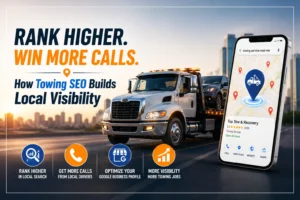
How Towing SEO Helps You Dominate Search Calls Across Neighbouring Cities
A driver breaks down three cities away from your yard. They open Google, type “tow truck near me,” and call the first company they see. That company might be smaller than you, have fewer trucks, and charge more. But they’re showing up and you’re not. That’s the entire towing SEO conversation in one real-world moment — and it’s playing out hundreds of times a day across every market in the country.
If your business is only visible in one city, you’re leaving a massive amount of call volume to operators who figured out local search before you did. This guide explains exactly how to change that.
Why Neighboring Cities Are Your Biggest Untapped Opportunity
Most tow operators build a website, claim their Google Business Profile for their home city, and stop there. Meanwhile, the cities 10, 15, and 20 miles away are full of stranded drivers searching Google and finding your competition.
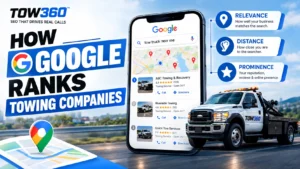
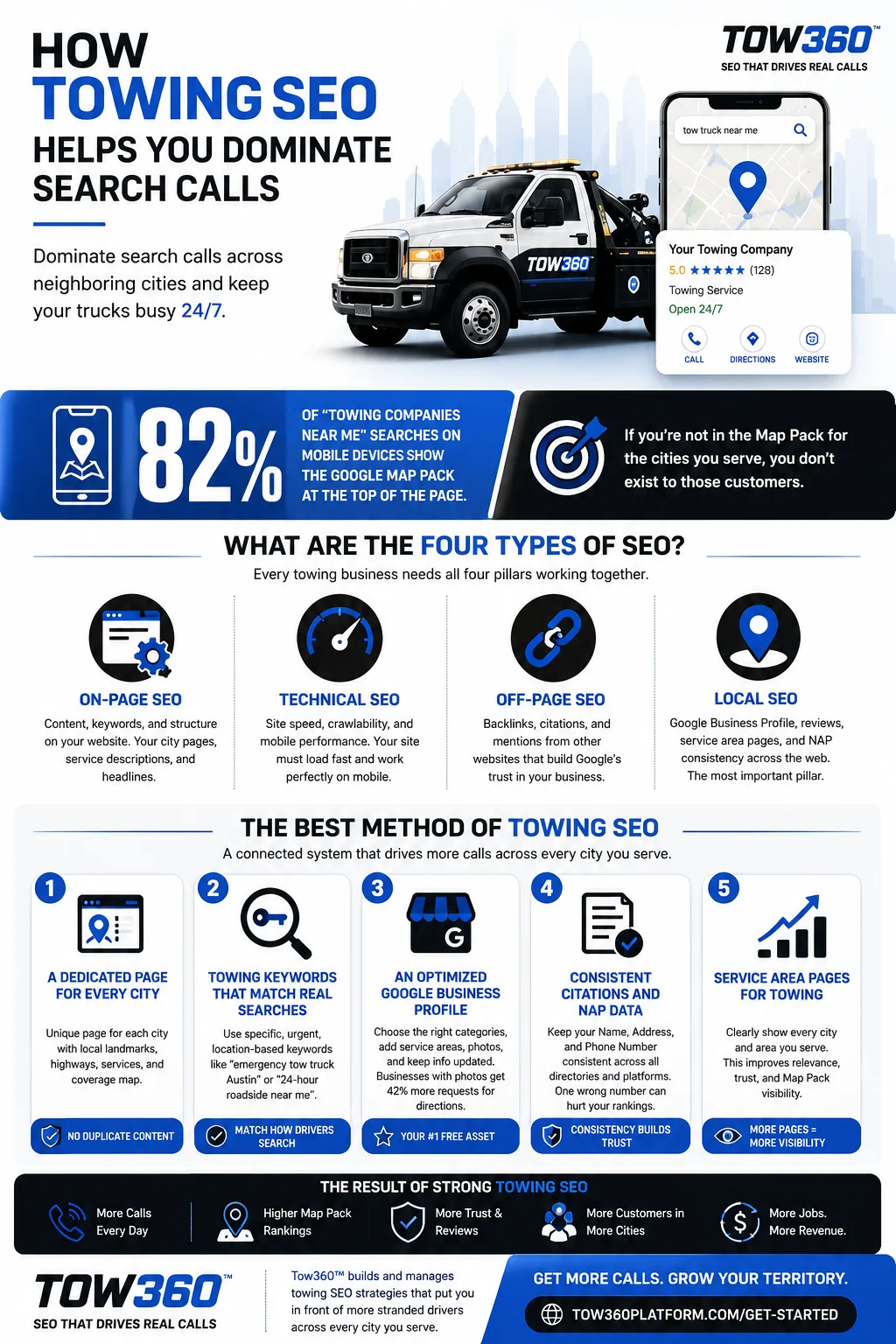
According to industry data, 82% of “towing companies near me” searches on mobile devices display the Google Map Pack at the very top of the page, bypassing traditional organic listings entirely.
That Map Pack shows three results. If you’re not in it for the cities you actually serve, you don’t exist to those customers.
Ready to Get More Towing Calls? Let’s Talk.
What Are Four Types of SEO?
Before building a multi-city strategy, every tow operator needs to understand the four pillars their online visibility is built on. SEO breaks down into four distinct disciplines that work together: on-page SEO, off-page SEO, technical SEO, and local SEO.
Here’s what each one means for your towing business specifically:
- On-Page SEO — the content, keywords, and structure on each page of your website. Your city pages, service descriptions, and headline copy all live here.
- Technical SEO — how fast your site loads, whether Google can crawl it, and whether it works on mobile. Mobile-first indexing is absolute in 2026 — your site must achieve sub-second load times. A stranded driver won’t wait.
- Off-Page SEO — the backlinks, citations, and mentions from other websites that build Google’s trust in your business. Every consistent directory listing helps.
- Local SEO — your Google Business Profile, reviews, service area pages, and NAP consistency across the web. For tow companies, this is the most important pillar of all.
All four work together. Neglect one and the others underperform.
What Is the Best Method of Towing SEO?
The operators dominating search calls across multiple cities aren’t doing one thing well — they’re executing a connected system where every element reinforces the others.
Towing company SEO that actually produces calls across neighboring cities is built on five fundamentals:
-
A dedicated page for every city you serve
If you serve multiple cities, you need a dedicated page for each one. It should include the city name in the title and URL, local landmarks and highways, specific services offered there, and a map showing your coverage area. Don’t copy and paste the same text with a different city name. Google detects thin content and penalizes it.
-
Towing keywords for Google that match real searches
Your customers aren’t searching “towing company.” They’re searching “emergency tow truck [city]” or “24-hour roadside near me.” Towing keywords for Google that convert are specific, urgent, and location-based. Build your page content around how a stranded driver actually types — not how a marketer thinks they type.
-
An optimized Google Business Profile for your primary location
Your tow company Google Business Profile is your single most powerful free asset. Choose “Towing Service” as your primary category, add “Emergency Towing” and “Roadside Assistance” as secondary categories, list every city and zip code you cover, and upload real photos of your trucks and team. Businesses with photos get 42% more requests for directions.
-
Consistent citations and NAP data everywhere
Your business name, address, and phone number need to match exactly across every directory — Yelp, Bing Places, Apple Maps, Facebook, BBB, and towing-specific directories. One tow company had their phone number wrong on six different sites — after fixing those, their map pack position moved from #5 to #2 in two weeks.
-
A steady stream of fresh reviews
Proximity accounts for 48–55% of local ranking variance, but review signals and keyword relevance dominate the top positions. Reviews are what you can control. Make getting them a system, not an afterthought.
Service Area Pages: The Engine of Multi-City Domination
This is where most tow companies either win or lose the neighboring city battle.
Service area pages for towing are dedicated pages on your website targeting each city or community within your service radius. Not a generic “we serve the following areas” list — actual pages, with actual content, built to rank for actual local searches.
A page targeting “Towing in [Neighboring City]” that includes local highway references, common breakdown spots, response time from your yard, and real customer reviews from that area sends every signal Google needs to rank you there.
If you serve five different cities, you need five different location-specific pages, each containing original data regarding that location’s specific market conditions. Search engines can more easily associate your services with specific locations and match your pages to relevant local searches.
Build ten of these right and you’ve just opened ten new call channels — each running 24 hours a day, at zero cost per call once the ranking is earned.
Local SEO for Tow Trucks: Why Mobile Speed Changes Everything
Local SEO for tow trucks lives or dies on mobile performance. The customer searching for a tow is never sitting at a desktop. They’re on the side of the road, on a phone, possibly in the rain, definitely stressed.
Landing pages loading in under 2 seconds convert at 2–3 times the rate of pages loading in 4+ seconds. That same principle applies to every page on your towing website. A slow-loading city page doesn’t just frustrate the user — it ranks lower because Google factors page speed directly into local search results.
Fast site. Mobile-first design. Clickable phone number at the top of every page. These aren’t nice-to-haves for a towing website. They’re the difference between a call and a bounce.
SEO for Roadside Assistance: It’s Its Own Search Category
Roadside assistance and towing overlap — but they’re not identical in how customers search.
SEO for roadside assistance requires targeting a distinct set of search terms: “battery jump start near me,” “flat tire help [city],” “lockout service [neighborhood].” These searches carry the same urgency as towing searches but come from a different moment — a driver who doesn’t need a tow, just immediate help on the spot.
If your business offers roadside services, you need dedicated content for those searches. A towing page won’t rank for roadside terms. A combined service page dilutes both. Build separate content for each service category and capture both call types from every city you serve.
What Is the 80/20 Rule in SEO?
Towing operators often ask: with so many SEO tasks to handle, where should I actually focus?
The answer is the 80/20 rule. The 80/20 rule in SEO states that 80% of your organic traffic comes from just 20% of your SEO efforts — a small number of pages, keywords, and strategies drive the majority of your search visibility and results.
For a towing company, that 20% looks like this:
Your Google Business Profile. Your top three to five service area pages. Your review generation system. Your site’s mobile load speed. Your NAP consistency across major directories. Most businesses never get to the advanced stuff because they haven’t nailed the fundamentals. And the fundamentals alone, done properly, are enough to outrank most local competitors.
Towing website ranking tips that focus on these five fundamentals will outperform a bloated strategy that tries to do everything at once. Nail the 20% first. Let it compound. Then build from a position of strength.
Multi-City SEO: The Compound Advantage
The real power of a multi city towing SEO strategy is what happens over time.
A city page built in month one is still ranking in month twelve — and getting stronger, not weaker, as it accumulates reviews and authority signals. A Google Business Profile optimized today keeps generating calls without a per-click cost attached to each one.
Organic local search leads have a 60–80% close rate with no marginal cost per call once you’ve earned those rankings.
That’s the compounding advantage paid ads can never match. Every ranking you earn is an asset. Every review you collect is a trust signal that works indefinitely. Build enough of them across enough cities and your towing business becomes the obvious first call across your entire service area — not just your home city.
Frequently Asked Questions
How long does towing SEO take to produce results?
Most tow companies see meaningful Google Business Profile and Map Pack improvements within 30–60 days of active optimization. City page rankings typically build over 3–6 months. The full compounding effect — where multiple cities are driving consistent call volume — typically takes 6–12 months of consistent execution.
Do I need a separate website for each city I serve?
No. All your city pages live on one domain. In fact, having them on the same domain strengthens your overall site authority as each page earns rankings and backlinks. Multiple websites for multiple cities is a common misconception — and it splits your authority across domains instead of concentrating it.
How many service area pages do I actually need?
One per city you actively serve within your response radius. If you can realistically reach a city in 20–30 minutes and want calls from it, build a page for it. Operators covering 10 cities should have at least 10 service area pages — each with unique, locally relevant content.
Does Google Ads replace the need for towing SEO?
No — and operators who rely on ads alone are paying for every single call indefinitely. SEO and Google Ads serve different roles. Ads produce immediate calls while SEO is being built. SEO produces calls at zero cost-per-click once rankings are earned. The strongest towing companies run both simultaneously.
Can I do towing SEO myself or do I need an agency?
The basics — claiming and optimizing your GBP, generating reviews, fixing your NAP citations — are things any operator can do. The technical side — site speed, schema markup, city page structure, backlink building — is where a specialized partner produces meaningfully faster results. For most operators, the ROI on professional SEO management pays for itself within the first 60–90 days.
Your Next Call Could Be Coming From a City You’re Not Ranked In Yet
That’s the reality of towing search in 2026. The operators generating the most calls across their entire service area aren’t the biggest or the best-funded. They’re the ones who understood that every city within their radius is a call channel — and built the SEO infrastructure to open every one of them.
Towing SEO done right is not a one-time project. It’s a system of city pages, optimized profiles, consistent reviews, and fast mobile pages that works every hour of every day — generating calls from neighborhoods your competitors haven’t thought to target yet.
Tow360™ builds this system for towing operators across the country. City pages, GBP management, review generation, technical optimization, and real-time call tracking — all in one platform, built exclusively for towing companies.
Claim your market at tow360platform.com/get-started/